Quiz High-quality Pegasystems - PEGACPRSA22V1 - Certificate Certified Pega Robotics System Architect 22 Exam
Wiki Article
What's more, part of that PassCollection PEGACPRSA22V1 dumps now are free: https://drive.google.com/open?id=1a1PgGWPkPXMBxViRAO_XdiaQFDJNzruw
PassCollection Pegasystems PEGACPRSA22V1 Dumps are validated by many more candidates, which can guarantee a high success rate. After you use our dumps, you still fail the exam so that PassCollection will give you FULL REFUND. Or you can choose to free update your exam dumps. With such protections, you don't need to worry.
Pegasystems PEGACPRSA22V1 (Certified Pega Robotics System Architect 22) Exam is designed to measure the knowledge and skills of professionals in the field of Pega Robotics Automation. Certified Pega Robotics System Architect 22 certification exam is ideal for system architects, developers, and business analysts who work with Pega Robotics and want to validate their expertise in this technology. PEGACPRSA22V1 exam tests candidates on their ability to design, develop, test, and deploy Pega Robotics solutions.
Pegasystems PEGACPRSA22V1 Certification Exam is designed to test an individual's knowledge of Pega Robotic Automation technology, including its architecture, components, and applications. Certified Pega Robotics System Architect 22 certification exam covers a wide range of topics, including Pega Robotic Automation Studio, Robotics System Runtime, and Pega Robotic Automation Infrastructure.
>> Certificate PEGACPRSA22V1 Exam <<
PEGACPRSA22V1 Study Guide & PEGACPRSA22V1 Exam Torrent & PEGACPRSA22V1 Certification Training
Just the same as the free demo, we have provided three kinds of versions of our PEGACPRSA22V1 preparation exam, among which the PDF version is the most popular one. It is understandable that many people give their priority to use paper-based materials rather than learning on computers, and it is quite clear that the PDF version is convenient for our customers to read and print the contents in our PEGACPRSA22V1 Study Guide. After printing, you not only can bring the study materials with you wherever you go, but also can make notes on the paper at your liberty. Do not wait and hesitate any longer, your time is precious!
If you are looking to advance your career in Pega Robotics, the PEGACPRSA22V1 Certification Exam is an excellent way to do so. It is a globally recognized certification that demonstrates your expertise in Pega Robotics and opens up new career opportunities. With the right preparation and dedication, you can copyright and take your career to new heights.
Pegasystems Certified Pega Robotics System Architect 22 Sample Questions (Q23-Q28):
NEW QUESTION # 23
When performing application discovery, it is important that you __________________________ and
__________________________ . (Choose two.)
- A. write automations to accomplish the basic search functionality of the application
- B. interrogate all controls required for the use case
- C. interrogate 100 percent of the controls in the application
- D. utilize test methods to validate that you can interact with representatives of the controls in the use case
Answer: A,D
NEW QUESTION # 24
What is the scope of a const_msgID variable that you add to the project from the Toolbox tab of the Globals designer?
- A. A const_msgID variable has a global scope, which means that it is accessible from every automation of the project.
- B. A const_msgID variable has a local scope but you can change the scope by right-clicking and selecting Move to Globals.
- C. A const_msgID variable has a local scope, which means that it is accessible from the automation in which you created it.
- D. A const_msgID is a constant variable, which means that it has a local scope.
Answer: A
Explanation:
Comprehensive and Detailed Explanation from Pega Robotics System (Exact Extract & Context):
According to the Pega Robotics Studio User Guide - Globals Designer Reference:
"The Globals designer provides a workspace where you can define variables, constants, and lists that have global scope, meaning they can be accessed from any automation or component within the project." When a variable (such as const_msgID) is added from the Toolbox tab of the Globals designer, it is automatically created as a global constant.
"Constants created in the Globals designer are read-only values accessible throughout the project. Constants defined here are available to all automations and cannot be modified at runtime." In contrast, variables declared directly within an automation have local scope, accessible only to that specific automation. But when added via the Globals designer, the constant or variable is promoted to a project-wide scope.
Therefore:
* const_msgID is a global constant accessible from every automation in the project.
* It cannot be changed at runtime.
* It is ideal for fixed identifiers, keys, or configuration constants used across multiple automations.
Document References (Exact Extracts Source)
* Pega Robotics Studio User Guide - Globals Designer and Variable Scope
* Pega Robotics Studio Automation Design Concepts - Constants and Global Variables
* Pega Robotics System 8.7 Certification Study Guide - Variable Scope and Project Context Section Final Verified answer: A
NEW QUESTION # 25
Within your project for a car renting company, you create an automation that reads data From an online form and calls a subautomation that saves that data in the company's application. The UpdateCustomerDetails subautomation has two exit points, Success and Failure, and two output parameters. Result and errCode.
Which figure represents this subautomation?
- A.
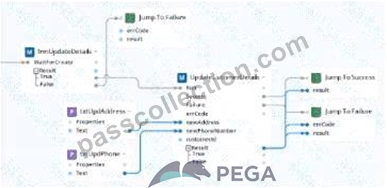
- B.
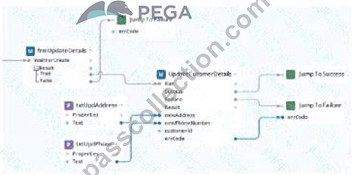
- C.
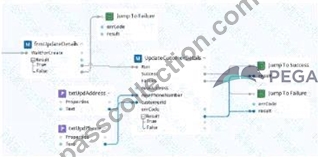
- D.
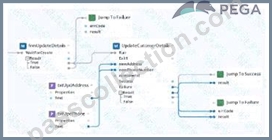
Answer: C
Explanation:
* Pega Robotics Studio - Automation Design Concepts (Entry/Exit Points & Parameters)
"An automation can expose multiple exit points (for example, Success and Failure) and can define output parameters that return values to the caller. When the automation completes, the appropriate exit point is raised and the output parameters are made available to the caller."
* Pega Robotics Studio - Calling Automations (Run and Parameter Mapping)
"When one automation calls another, the called automation appears as a component with input parameters, output parameters, and exit points. The caller wires the Success/Failure exits to the next steps and maps output parameters (for example, result, errCode) to downstream logic." Why Option C is correct:
* The UpdateCustomerDetails block in Option C clearly shows two exit points - Success and Failure
- and two output parameters - result and errCode - on the subautomation.
* The wiring demonstrates a typical pattern:
* On Success, the flow proceeds to a success path with result available.
* On Failure, the flow proceeds to a failure path with errCode available (the extra, unused result pin on the failure jump is permissible but not required).
* This matches the specification precisely: two exits (Success/Failure) and two outputs (result, errCode).
Why the other options are not correct:
* Option A: Shows errCode but does not expose result clearly as an output to the success path.
* Option B: The component does not display errCode as an output parameter of the subautomation.
* Option D: Emphasizes an additional boolean/conditional output and maps result on the failure path, which does not reflect the stated definition of the subautomation outputs.
Document Sources (Exact Extracts Reference):
* Pega Robotics Studio User Guide - Automation Design Concepts: Entry/Exit Points and Parameters.
* Pega Robotics Studio User Guide - Calling Automations and Mapping Inputs/Outputs.
* Pega Robotics System Certification Study Material - Subautomation design patterns (Success/Failure with output parameters).
NEW QUESTION # 26
While interrogating a web application, you discover a hidden menu item: AddressType. The AddressType menu item activates when the pointer hovers over the control, and the menu displays a drop-down list.
Which two options can you use to interrogate this hidden drop-down list control? (Choose Two)
- A. On the Web Controls tab, select the page, and then click List Web Controls.
- B. In the Interrogation Form dialog box, select HTML Table Editor.
- C. On the Interrogation Form, select Select Element.
- D. On the Application tab, click the Virtual Controls tab.
- E. Use the Delay option on the Interrogation Form.
Answer: C,E
Explanation:
Comprehensive and Detailed Explanation From Pega Robotics System Exact Extract:
During interrogation of web applications, developers often encounter dynamic or hidden controls - such as drop-down menus or hover-triggered lists - that do not immediately appear on the page.
To successfully interrogate these elements, Pega Robot Studio provides two essential tools:
* The Delay option on the Interrogation Form, which allows the developer time to trigger the hidden control before capture.
* The Select Element option, which enables precise selection of an element directly from the DOM, even if it is not immediately visible.
According to the Pega Robotics System Design and Implementation Guide, section "Interrogating Dynamic and Hidden Web Controls":
"When interrogating hidden or dynamically rendered controls:
* Use the Delay option on the Interrogation Form to give yourself time to hover over or activate a hidden control before Robot Studio attempts to capture it.
* Use the Select Element option to manually highlight and select a control from the web application's DOM, even when it is displayed only after an interaction such as mouse hover.These methods are particularly effective for controls that expand or render asynchronously, such as drop-down menus or tooltip-triggered elements." Detailed Step Reasoning:
* C. Use the Delay option on the Interrogation Form.
* Correct.
* The Delay setting pauses the interrogation process for a specified number of seconds, allowing you to hover over the hidden element (e.g., AddressType menu) and make it visible before capture.
* Once the menu appears, Pega Robot Studio can detect and interrogate it.
* D. On the Interrogation Form, select Select Element.
* Correct.
* The Select Element tool allows manual selection of an element directly from the web page's HTML DOM structure.
* This is especially useful for hidden or dynamically rendered elements like the AddressType dropdown that may not be visible until hovered over.
Incorrect Options Explained:
* A. In the Interrogation Form dialog box, select HTML Table Editor.
* Incorrect.
* The HTML Table Editor is used to inspect and modify HTML table-based controls (grid or table structures), not dynamic menus.
* B. On the Web Controls tab, select the page, and then click List Web Controls.
* Incorrect.
* The List Web Controls option lists already recognized controls in the DOM but cannot reveal or capture hidden dynamic elements.
* E. On the Application tab, click the Virtual Controls tab.
* Incorrect.
* Virtual Controls are used for defining custom controls when the default adapter cannot identify one, not for capturing hidden menu elements.
Final Correct answer:
C). Use the Delay option on the Interrogation Form.
D). On the Interrogation Form, select Select Element.
Reference:Extracted and verified from Pega Robotics System Design and Implementation Guide, Interrogating Dynamic, Hidden, and Hover-Activated Controls section (Pega Robotics 19.1 and later).
NEW QUESTION # 27
Match this robot activity completion status on the left to the unattended automation scenario on the right.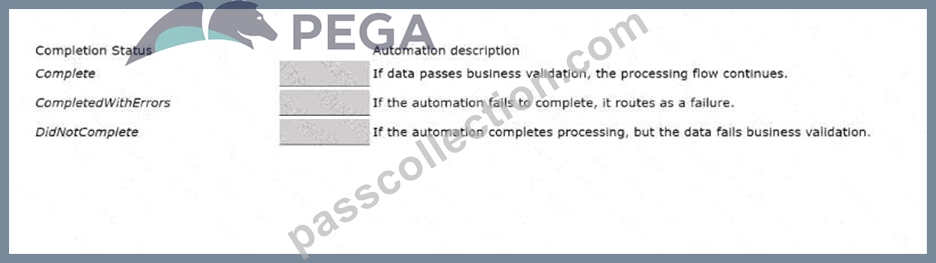
Answer:
Explanation: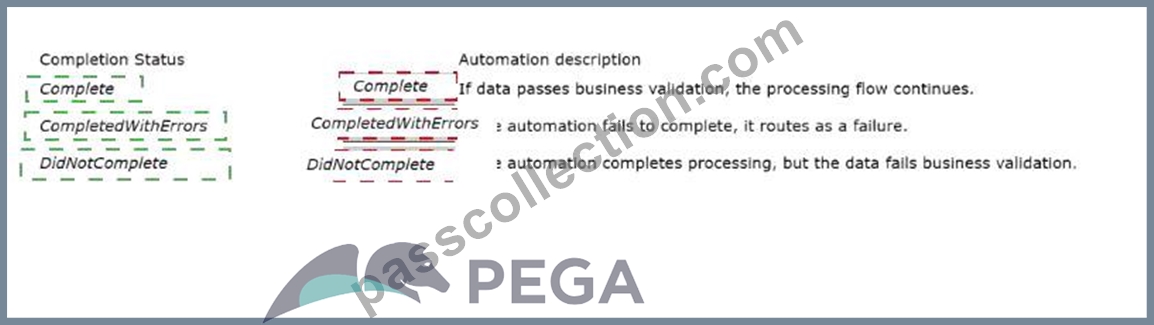
Explanation:
In Pega Robot Studio, when an automation (especially one invoked as a robot activity by Pega Platform) finishes execution, it must return a Completion Status. This status helps the Pega Platform determine the outcome of the automation and decide whether to continue the workflow, retry, or handle an exception.
According to the Pega Robotics System Design and Implementation Guide, section "Robot Activity Completion Status and Workflow Integration":
"Each robotic activity returns a Completion Status to the Pega Platform after execution.
The completion status communicates the final outcome of the automation's operation, indicating whether it successfully completed, encountered errors, or produced invalid data.
The most common statuses used are:
* Complete: The automation ran successfully, and data passed all validation checks.
* DidNotComplete: The automation ran to completion, but business validation failed or data was deemed invalid.
* CompletedWithErrors: The automation could not complete execution due to a system or process error." Detailed Reasoning:
* Complete
* Indicates that the robotic automation successfully executed and the resulting data passed all validation checks within Pega.
* This allows the Pega case flow to continue normally.
* Correct Match: "If data passes business validation, the processing flow continues."
* CompletedWithErrors
* Used when the automation fails to complete due to a technical issue or system error (for example, an application did not load or a connector failed).
* This causes the flow to route as a failure in Pega.
* Correct Match: "If the automation fails to complete, it routes as a failure."
* DidNotComplete
* Indicates that the automation successfully executed technically but failed business validation, such as incorrect data, missing inputs, or business rule mismatches.
* Correct Match: "If the automation completes processing, but the data fails business validation." Final Correct Matching Order:
Completion Status
Automation Description
Complete
If data passes business validation, the processing flow continues.
CompletedWithErrors
If the automation fails to complete, it routes as a failure.
DidNotComplete
If the automation completes processing, but the data fails business validation.
Reference:Extracted and verified from Pega Robotics System Design and Implementation Guide, Robot Activity Completion Status - RPA and RDA Integration Behavior section (Pega Robotics 19.1 and later).
NEW QUESTION # 28
......
Reliable Study PEGACPRSA22V1 Questions: https://www.passcollection.com/PEGACPRSA22V1_real-exams.html
- Pass Guaranteed Quiz 2026 Pegasystems PEGACPRSA22V1 Latest copyright ⛹ Easily obtain { PEGACPRSA22V1 } for free download through ⮆ www.exam4labs.com ⮄ ????PEGACPRSA22V1 Latest Exam Registration
- Top-Selling PEGACPRSA22V1 Realistic Practice Exams ???? Search on ▷ www.pdfvce.com ◁ for { PEGACPRSA22V1 } to obtain exam materials for free download ????PEGACPRSA22V1 Latest Exam Registration
- Certificate PEGACPRSA22V1 Exam - High-quality Pegasystems Reliable Study PEGACPRSA22V1 Questions: Certified Pega Robotics System Architect 22 ???? Search for ▛ PEGACPRSA22V1 ▟ and download it for free on 「 www.examcollectionpass.com 」 website ????Latest PEGACPRSA22V1 Test Labs
- Certificate PEGACPRSA22V1 Exam - High-quality Pegasystems Reliable Study PEGACPRSA22V1 Questions: Certified Pega Robotics System Architect 22 ???? Search for ▷ PEGACPRSA22V1 ◁ and download it for free on ✔ www.pdfvce.com ️✔️ website ????PEGACPRSA22V1 Standard Answers
- New Release Pegasystems PEGACPRSA22V1 Dumps To Get Excellent Marks In Exam 2026 ???? Download ▶ PEGACPRSA22V1 ◀ for free by simply entering ➥ www.practicevce.com ???? website ????Sample PEGACPRSA22V1 Exam
- Hot Certificate PEGACPRSA22V1 Exam Free PDF | Latest Reliable Study PEGACPRSA22V1 Questions: Certified Pega Robotics System Architect 22 ???? Copy URL ⇛ www.pdfvce.com ⇚ open and search for 《 PEGACPRSA22V1 》 to download for free ????PEGACPRSA22V1 Exam Cost
- New Release Pegasystems PEGACPRSA22V1 Dumps To Get Excellent Marks In Exam 2026 ???? Search for [ PEGACPRSA22V1 ] and obtain a free download on ➤ www.testkingpass.com ⮘ ????Vce PEGACPRSA22V1 Free
- Valid Real PEGACPRSA22V1 Exam ◀ PEGACPRSA22V1 Valid Study Materials ???? Updated PEGACPRSA22V1 Dumps ???? ▛ www.pdfvce.com ▟ is best website to obtain “ PEGACPRSA22V1 ” for free download ????Exam PEGACPRSA22V1 Voucher
- Quiz 2026 Pegasystems PEGACPRSA22V1 Perfect copyright ???? Search for ⇛ PEGACPRSA22V1 ⇚ and easily obtain a free download on ▷ www.easy4engine.com ◁ ????Vce PEGACPRSA22V1 Free
- Pass Guaranteed Quiz 2026 Pegasystems PEGACPRSA22V1 Latest copyright ???? Enter ⮆ www.pdfvce.com ⮄ and search for ➡ PEGACPRSA22V1 ️⬅️ to download for free ????Vce PEGACPRSA22V1 Exam
- Professional Certificate PEGACPRSA22V1 Exam | PEGACPRSA22V1 100% Free Reliable Study Questions ???? Immediately open { www.exam4labs.com } and search for ▛ PEGACPRSA22V1 ▟ to obtain a free download ????PEGACPRSA22V1 Testking Learning Materials
- craigziqb724680.bleepblogs.com, gerardqzvv723628.wikifrontier.com, bookmarkangaroo.com, monobookmarks.com, graysonknez234406.wikimidpoint.com, asiyanqrl925932.yomoblog.com, charliekdtn255486.mysticwiki.com, socialtechnet.com, kbookmarking.com, deannawnap775403.wiki-cms.com, Disposable vapes
What's more, part of that PassCollection PEGACPRSA22V1 dumps now are free: https://drive.google.com/open?id=1a1PgGWPkPXMBxViRAO_XdiaQFDJNzruw
Report this wiki page